Offspring 2025: De Ateliers | De Relaties
- 15 May – 1 June 2025
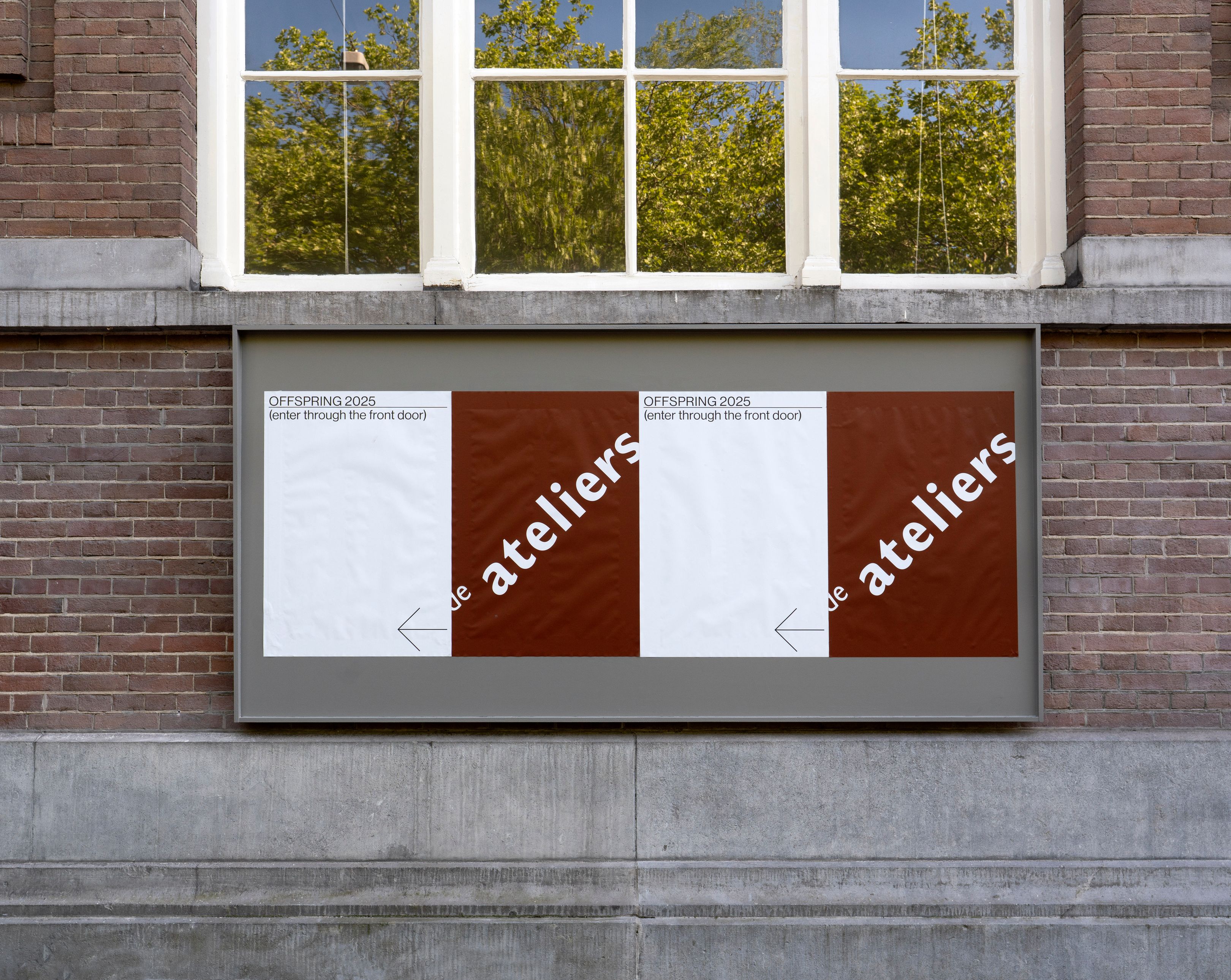
In 1963, an independent artists’ institute was founded in a former deaconry house and barracks in Haarlem, North Holland. Initially called Academie ‘63, the founding artists changed their minds about the name only two years after the opening, renaming it Ateliers ‘63. It was a change that sought to articulate the institute’s inception as an alternative to ac ademic contexts that have (especially then, though perhaps always) prevented more horizontal peer-to-peer structures for learning and development. Artists within the program have never been students but ‘participants’; never taught as such but rather guided. Individual artistic experimentation has thus long-since been fostered within this shared and collective environment—from the hundreds of young artists that came through the doors of Ateliers ’63, to all those since the institute moved in 1992 to its current location at Stadhouderskade 86 in Amsterdam, the former home of the Rijksakademie.
One of the most emblematic aspects of what is now more commonly known as De Ateliers is its studio visits pro gramme—a guiding principle that has been in place since the early days of the institute. Every Tuesday the participants are asked to open their studio doors for other artists, and the occasional critic or curator to enter. Though studio visits are a fixture of most academic and post-academic contexts (indeed, even in the careers of seasoned artists), at De Ateliers the element of surprise makes for an encounter that is rather unusual. In theory, anyone De Ateliers invites to join as a tu tor—which has included people such as Jan Dibbets, stanley brouwn, Marlene Dumas and Steve McQueen—could at any moment walk into a participant’s studio and strike up a con versation. The expectation for the participants to be avail able every Tuesday comes with no assurance that they will be visited, as it is the tutors themselves—whether visiting for a guest session, or as regulars within the programme—who decide which artists they visit and for how long. Despite the potential for the artists to feel nervous about this exposure, the demand is in fact one of radical openness: be there, be ready, be known.
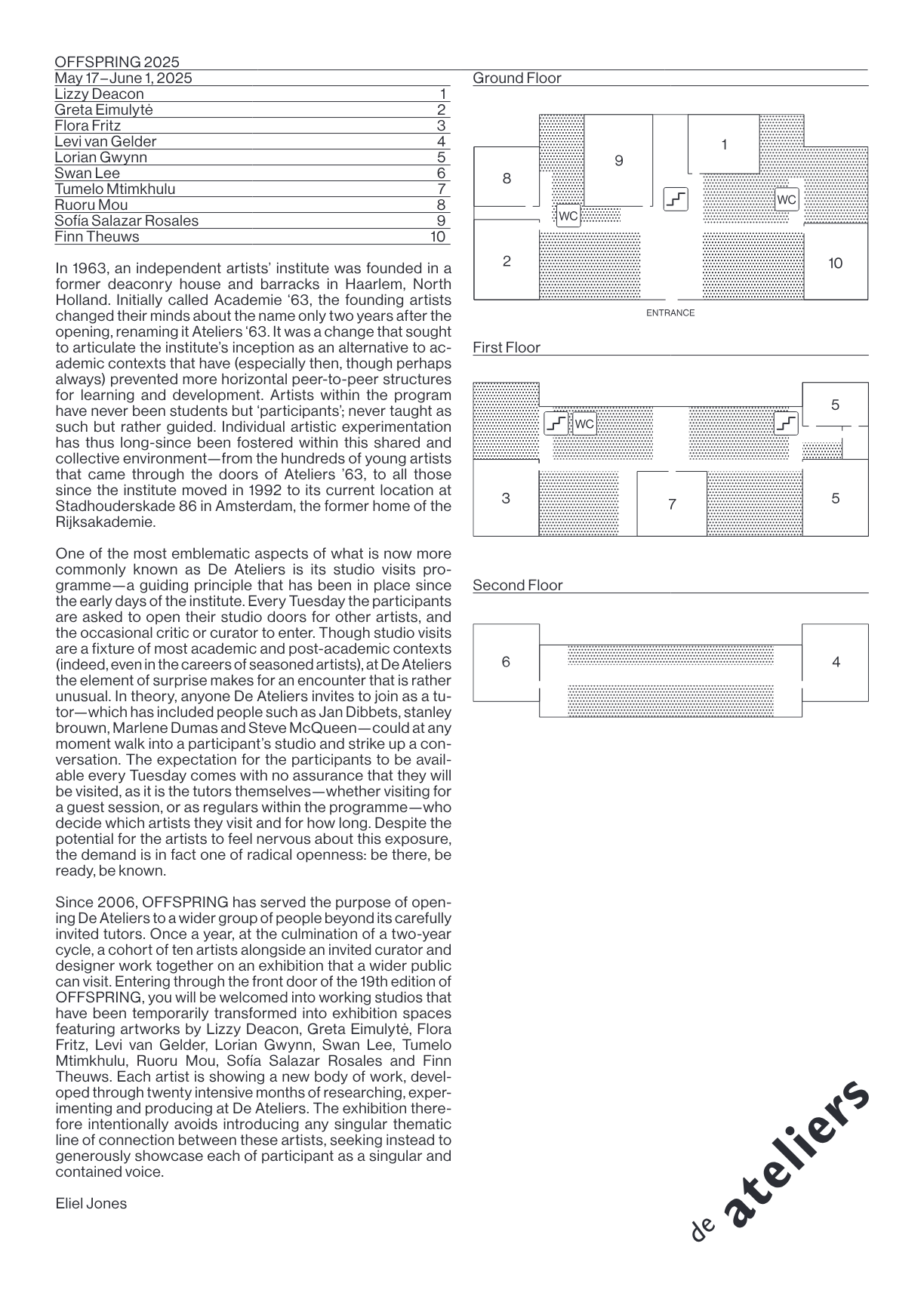
Since 2006, OFFSPRING has served the purpose of open ing De Ateliers to a wider group of people beyond its carefully invited tutors. Once a year, at the culmination of a two-year cycle, a cohort of ten artists alongside an invited curator and designer work together on an exhibition that a wider public can visit. Entering through the front door of the 19th edition of OFFSPRING, you will be welcomed into working studios that have been temporarily transformed into exhibition spaces featuring artworks by Lizzy Deacon, Greta Eimulytė, Flora Fritz, Levi van Gelder, Lorian Gwynn, Swan Lee, Tumelo Mtimkhulu, Ruoru Mou, Sofía Salazar Rosales and Finn Theuws. Each artist is showing a new body of work, devel oped through twenty intensive months of researching, exper imenting and producing at De Ateliers. The exhibition there fore intentionally avoids introducing any singular thematic line of connection between these artists, seeking instead to generously showcase each of participant as a singular and contained voice. —Eliel Jones
documentatie
documenten
colofon
- samenstelling en tekstenEliel Jones
- ontwerpSabo Day (geassisteerd door Augustinas Milkus)
- productieNina Oude Ophuis,Dafne Gotink
- techniekSjoerd van Leeuwen,Fiachra Corr,Julia Lok
- begeleiding tentoonstellingCharlie Prodger,Ima-Abasi Okon,Martijn Hendriks,David Jablonowski