Power Man, Amsterdam Art Weekend 2018
- 23–25 November, 2018
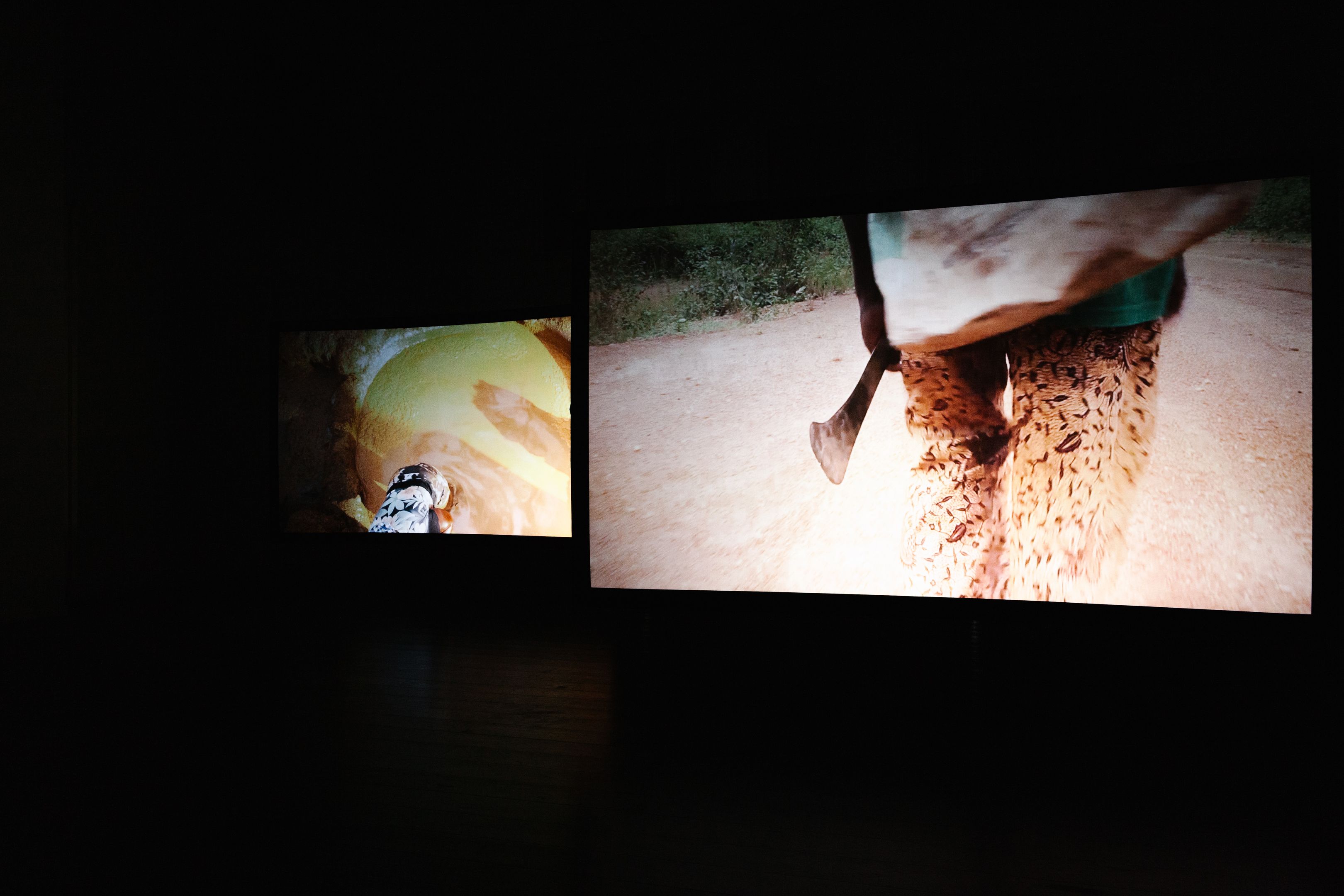
For Amsterdam Art Weekend 2018, De Ateliers present new film works by former participant Karimah Ashadu (b. London, 1985). The exhibition includes the two-channel installation Red Gold and her most recent film Sodoko (Power Man), featuring an area boy from the slums of Lagos.
‘Power Man/Power Man (Sodoko)’ (2018) is premiered at De Ateliers, featuring a so-called area boy from the slums of Lagos. We see a young man shadow boxing at the break of dawn. Fists drawn, mouth tense, eyes curt and unflinching. His skin recedes into darkness, dim light overhead skims his lithe figure. Skirmishing in and out of the light he has no decipherable opponent. On another channel, a young man diligently at work is chopping with his axe, never revealing what he is cutting up. The cropping of the image, the sparse light, the raw sound and the monumental size of the projections make a sinister quality palpable. The work is compelling and engaging, not only visually but also in auditive and haptic terms. Closely linked to sculpture and performance, Ashadu’s newest film installation triggers a bodily experience of the moving image.
The two-channel installation ‘Red Gold’ (2016) was commissioned by the Biennale de l’Image en Mouvement at the Centre d’Art Contemporaine in Geneva. Like other films of Ashadu, this work addresses labour, craft and industry in Nigeria, in this case the production of palm oil. Before Nigeria’s independence in the 1960s, the country stood as one of the world’s biggest cultivators and exporters of palm oil. However, in the wake of the discovery of crude oil, the sector was abandoned. The film centres on a group of farmers producing palm oil in Ekiti state, Western Nigeria. Self-sufficient and tremendously hard working, they lease the land from a prince, whose family has ruled the area for generations. One channel portrays the farmers, the other the prince, Mr Sesan.
Both works portray activities in real time, without a beginning or an end. Although the sequences are carefully edited, the overall sense one gets from looking at Ashadu’s films is an experience of duration that is uninterrupted. As the French film critic Serge Daney once wrote, cinema has the magical power to portray time itself, to reveal how time actually manifests itself. To him, this capacity is the true nobility of film. Ashadu’s films, where scenes do not necessarily ensue from previous scenes, bear new testimony to...